

Mixed Berry Galette (Rustic, Jammy & Stunning with Minimal Effort)
Prep Time: 20 minutes | Chill Time: 30 minutes | Cook Time: 40 minutes | Total Time: 1 hour 30 minutes | Servings: 8 | Calories: 280 kcal per serving
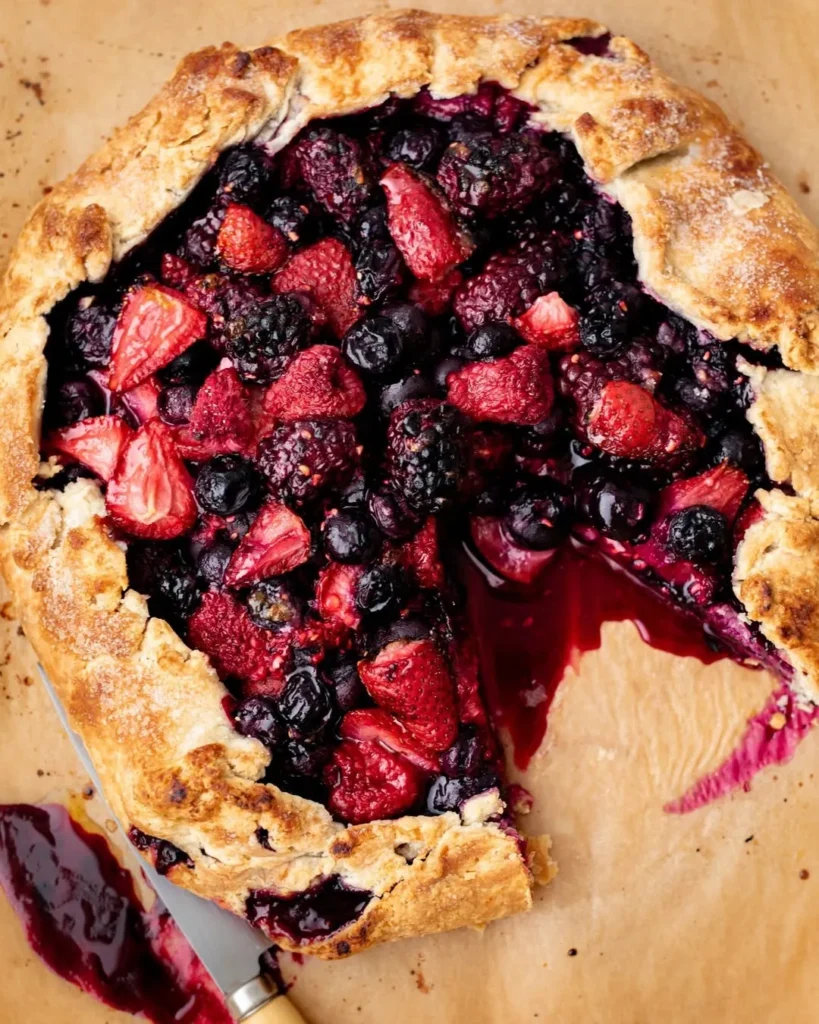
Mixed berry galette is a free-form, open-faced pastry of buttery, flaky rough puff dough folded casually around a jammy, jewel-bright filling of mixed berries tossed with sugar and lemon that bubbles and sets during baking into something that looks wildly impressive and is genuinely forgiving to make. The crust is golden, shatteringly crisp at the edges, and tender where it meets the filling. The berries are soft and intensely flavored. The imperfect folded border is the whole point — this is a dessert that looks better for being slightly rough around the edges.

This is the dessert that requires no pie dish, no crimping technique, no perfect pastry skills. Roll it out on parchment. Pile the berries in the center. Fold the edges over. Bake. The rusticity is the aesthetic and it is genuinely beautiful.
Twenty minutes to prep. Thirty minutes to chill. Forty minutes to bake. A galette that looks like a professional made it and proves that the most impressive pastry is often the simplest one.
Why You Will Love This Recipe
Mixed berry galette belongs in your dessert rotation from the first time you make it. Here is what makes this recipe worth making.
It is the most forgiving pastry you will ever make. Cracks get folded over. Tears get pinched together. Uneven edges become part of the character. There is no wrong way for a galette to look.
No special equipment is needed. No pie dish. No tart tin. No pastry weights. A baking sheet, a sheet of parchment, and a rolling pin. That is all.
The same dough works for every galette you will ever make. Sweet or savory. Summer berries or autumn apples. Roasted vegetables or caramelized onions and cheese. One dough recipe, a year of galettes.
It is faster than pie and more impressive than a crumble. The open format means the filling reduces and concentrates during baking in a way that a covered pie cannot. The berries become more intensely flavored than they went in.
The leftovers are as good as the day it was made. Room temperature the next morning with coffee. Warmed briefly in the oven. Cold with cream. All excellent.
Ingredients
For the galette dough:
- 1¼ cups (160g) all-purpose flour
- 1 tablespoon granulated sugar
- ½ teaspoon salt
- ½ cup (115g) unsalted butter, very cold, cut into small cubes
- 3–5 tablespoons ice water
- 1 teaspoon apple cider vinegar or white vinegar (keeps the dough tender)
For the berry filling:
- 3 cups (450g) mixed berries — blueberries, raspberries, blackberries, sliced strawberries, or any combination
- 3 tablespoons granulated sugar
- 1½ tablespoons cornstarch
- 1 tablespoon fresh lemon juice
- 1 teaspoon lemon zest
- ½ teaspoon pure vanilla extract
- Pinch of salt
- Pinch of cinnamon (optional)
For assembly:
- 2 tablespoons almond flour or plain breadcrumbs (for the base of the filling area — absorbs excess juice)
- 1 egg, beaten with 1 tablespoon of water (egg wash)
- 1½ tablespoons coarse sugar or demerara sugar (for the border)
For serving:
- Vanilla ice cream or whipped cream
- Crème fraîche
- Fresh mint leaves
- Extra lemon zest
Equipment Needed
- Large mixing bowl or food processor
- Pastry cutter or two forks (if making dough by hand)
- Baking sheet
- Parchment paper
- Rolling pin
- Sharp knife or bench scraper
- Pastry brush for egg wash
- Small bowl for the filling
Instructions
Step 1: Make the dough. Combine flour, sugar, and salt in a large bowl. Add the cold butter cubes. Using a pastry cutter, two forks, or your fingertips, work the butter into the flour until the mixture resembles coarse crumbs with some larger, flat pea-sized butter pieces still clearly visible. Those flat pieces of butter are what create the flaky layers. Do not work it to a uniform fine crumb.
Step 2: Add the vinegar to 3 tablespoons of ice water. Drizzle over the flour and butter mixture one tablespoon at a time, tossing with a fork after each addition. Add only enough water for the dough to just come together when pressed — it should look shaggy and rough, not smooth. Add up to 2 more tablespoons of ice water if needed. The dough must not be wet or smooth at this stage.
Step 3: Turn the dough out onto a lightly floured surface. Press it together into a flat disc — do not knead. Wrap tightly in plastic wrap and refrigerate for at least 30 minutes. Cold dough is manageable dough. Warm dough is sticky dough that tears and shrinks in the oven.
Step 4: While the dough chills, prepare the berry filling. Combine the mixed berries, sugar, cornstarch, lemon juice, lemon zest, vanilla, salt, and cinnamon if using in a medium bowl. Toss gently until every berry is coated. The cornstarch will thicken the berry juices during baking and prevent a soggy, watery filling. Set aside.
Step 5: Preheat the oven to 200°C (400°F). Line a large baking sheet with parchment paper.
Step 6: Remove the dough from the fridge. On a lightly floured sheet of parchment paper, roll the dough into a rough circle approximately 30–33 cm (12–13 inches) in diameter and about 3–4 mm thick. It does not need to be a perfect circle. Uneven edges are part of the character of a galette. Slide the parchment and dough together onto the prepared baking sheet.
Step 7: Sprinkle the almond flour or breadcrumbs over the center of the dough, leaving a 6–7 cm (2½ inch) border clear around the edge. The almond flour or breadcrumbs absorb the excess berry juice during baking and prevent the pastry base from becoming soggy. This is an easy, invisible step that makes a significant difference.
Step 8: Spoon the berry filling over the almond flour layer, distributing the berries as evenly as possible and keeping the border clear. Do not mound the berries too high — a single even layer gives the best result.
Step 9: Fold the border of dough up over the edge of the filling, pleating it every 5–7 cm (2–3 inches) as you work around the circle. The pleats do not need to be uniform or neat. Press them lightly to help them hold their shape. If the dough cracks, simply press it back together — it will seal during baking.
Step 10: Brush the folded dough border generously with the egg wash. The egg wash gives the border its deep golden color and appetizing sheen.
Step 11: Sprinkle the coarse or demerara sugar over the egg-washed border. This creates a sparkling, slightly crunchy sugar crust on the finished galette.
Step 12: Refrigerate the assembled galette for 10–15 minutes before baking. Cold assembled pastry goes into a hot oven and holds its shape far better than room temperature pastry. This short chill is worth the extra time.
Step 13: Bake for 38–42 minutes until the crust is deeply golden all over — not pale gold, not light golden, but a genuine deep amber brown — and the filling is bubbling at the center. Bubbling filling means the cornstarch has activated and the filling will set properly as it cools.
Step 14: Remove from the oven and slide the galette still on its parchment onto a wire rack. Cool for at least 20 minutes before slicing. A galette sliced hot has a runny filling that spreads everywhere. Twenty minutes of patience produces a filling that holds together.
Step 15: Serve warm or at room temperature with vanilla ice cream, whipped cream, or crème fraîche. Scatter fresh mint leaves and a little extra lemon zest over the top just before serving.
Substitutes & Swaps
Mixed berries: Any single berry or any combination works. Fresh figs halved and layered in the filling are extraordinary in autumn. Sliced stone fruit — peaches, nectarines, plums, or cherries — all work with the same method and the same dough. Sliced apples or pears tossed with cinnamon, brown sugar, and a squeeze of lemon work for an autumn galette. The dough is universal.
All-purpose flour in the dough: A 1-to-1 gluten-free flour blend works for a gluten-free version. The dough is slightly more fragile and needs careful handling. Add 1 extra tablespoon of ice water and chill the dough for the full 30 minutes before rolling.
Unsalted butter: Salted butter works — omit the added salt in the dough. European-style butter with higher fat content produces a richer, more tender crust that is noticeably better than standard butter.
Almond flour under the filling: Plain fine breadcrumbs work identically to absorb excess juice. Ground walnuts or ground hazelnuts give a pleasant nuttiness. Plain crushed biscuits or graham crackers work in a pinch.
Cornstarch in the filling: Arrowroot powder works at the same quantity as a direct substitute. Tapioca starch works at the same quantity and gives a slightly shinier, more glossy filling. Plain flour works at 2 tablespoons in place of 1½ tablespoons cornstarch.
Coarse sugar for the border: Any coarse crystal sugar works — turbinado sugar, raw sugar, or demerara all give a sparkling, crunchy crust. Regular granulated sugar works but does not produce the same crunch or sparkle.
Variations
Peach and Raspberry Galette: Use 2 cups of sliced ripe peaches and 1 cup of raspberries. Add a pinch of cardamom and the zest of an orange to the filling. Add a thin layer of almond cream — softened butter, almond flour, egg, and sugar blended together — over the almond flour base before the fruit. Elegant and deeply flavored.
Apple Cinnamon Galette: Thinly slice 3 medium apples. Toss with brown sugar, cinnamon, cardamom, lemon juice, and a tablespoon of cornstarch. Arrange in overlapping circles over the almond flour base. Brush with egg wash, sprinkle with demerara sugar, bake at 200°C for 40–45 minutes. Classic autumn dessert.
Strawberry Rhubarb Galette: Use equal parts sliced strawberries and thinly sliced rhubarb. Increase the sugar to 4 tablespoons to balance the rhubarb’s tartness. A spring galette that uses the season’s best produce.
Chocolate Hazelnut Berry Galette: Spread a thin layer of chocolate hazelnut spread over the almond flour base before adding the berries. The chocolate layer melts into the pastry base during baking and adds a rich, nutty depth under the fruit.
Savory Galette: Omit the sugar from the dough. Fill with caramelized onions, roasted vegetables, or sliced tomatoes and fresh herbs. Top with crumbled feta or grated Gruyère. Fold and bake identically. The same dough becomes a completely different and equally excellent dish.
Tips & Tricks
Keep everything cold. Cold butter, ice water, cold dough, cold assembled galette. Temperature is the most important variable in galette making. Cold butter creates steam pockets during baking that push the pastry layers apart and produce the flaky, shatteringly crisp texture that defines a good crust. Warm butter produces a greasy, dense, crumbly pastry with no layers.
Leave visible butter pieces in the dough. The goal is not a uniform fine crumb. Pea-sized and flat almond-sized pieces of butter in the dough are exactly right. Those pieces melt in the hot oven and create the steam that separates the pastry into flaky layers. A uniformly fine crumb produces a shortbread texture, not a flaky one.
The dough will look too rough and shaggy. This is correct. A galette dough that comes together into a smooth ball in the bowl has too much water and will be tough after baking. It should look barely held together when pressed. It comes together fully when rolled out and baked.
Sprinkle almond flour or breadcrumbs under the filling. This step is invisible in the finished galette and takes fifteen seconds. It absorbs the excess juice released by the berries during baking and prevents the pastry base from becoming a pale, soggy disc. Always do this step.
Roll the dough on parchment. Rolling directly on parchment means no transfer step — the dough goes from rolling surface to baking sheet without being moved. Moving a rolled-out pastry disc is where most tears and stretching happen. Roll on parchment, slide onto the sheet, and the dough arrives perfectly intact.
Bake until deeply golden, not lightly golden. An underbaked galette has a pale, doughy, soft crust rather than a crisp, flaky one. The crust should be a genuine deep amber brown all over, including the base. If the top is browning but the base needs more time, move the baking sheet to a lower rack for the last 10 minutes.
Wait for the filling to bubble. The cornstarch in the filling only activates above a certain temperature and only when the filling has been bubbling for at least a few minutes. A filling that has not bubbled will not set properly. Wait for visible, active bubbling at the center of the galette — not just at the edges — before pulling it from the oven.
Nutrition Information (Per Serving)
| Nutrient | Amount |
|---|---|
| Calories | 280 kcal |
| Total Fat | 13g |
| Saturated Fat | 8g |
| Carbohydrates | 38g |
| Fibre | 3g |
| Sugars | 16g |
| Protein | 4g |
| Sodium | 160mg |
Nutrition is based on one slice from an 8-slice galette made with mixed berries, butter pastry dough, and coarse sugar. Ice cream and cream not included.
Frequently Asked Questions (FAQs)
Can I use frozen berries?
Yes. Do not thaw them first. Toss straight from frozen with the sugar, cornstarch, and lemon. Frozen berries release significantly more juice than fresh — increase the cornstarch to 2 tablespoons to compensate. The bake time increases by 5–8 minutes. Wait for active bubbling at the center before pulling the galette from the oven.
My pastry crust shrank and pulled away from the filling during baking. What happened?
The dough was overworked, too warm when it went in, or the resting time in the fridge was skipped. Overworked dough develops too much gluten which contracts in the oven. Warm dough also contracts as it hits the heat. Always rest the dough for the full 30 minutes in the fridge and chill the assembled galette for 10–15 minutes before baking.
Can I make the dough ahead of time?
Yes. The dough keeps in the fridge for up to 3 days, wrapped tightly. It also freezes well — wrap the disc tightly and freeze for up to 2 months. Thaw overnight in the fridge before rolling. The filling should be made fresh the day of baking — berries sitting in sugar and cornstarch for too long release too much liquid.
My galette filling is runny even after cooling. What went wrong?
Either the filling did not bubble long enough during baking or there was not enough cornstarch. The filling needs to reach a full, active bubble at the center — not just at the edges — for the cornstarch to activate properly. If using very juicy fruit, increase the cornstarch by half a tablespoon.
Can I make individual galettes?
Yes. Divide the dough into 8 equal portions. Roll each into a 15 cm (6 inch) circle. Fill with a generous spoonful of berries. Fold and bake at 200°C for 22–25 minutes until deeply golden and bubbling. Individual galettes are perfect for dinner parties and cook faster than one large galette.
How do I store and reheat leftovers?
Store the cooled galette loosely covered at room temperature for up to 2 days. The crust softens slightly overnight. To restore the crispness, place on a baking sheet in a 175°C oven for 8–10 minutes. This brings the crust back to life almost completely. Do not cover tightly or refrigerate unless necessary — cold and sealed storage softens the pastry significantly.
Can I make this dairy-free?
Yes. Replace the butter in the dough with very cold vegan butter or solid coconut oil. The technique stays identical — keep it cold, work it into the flour until crumbly, add ice water. The crust is slightly less flaky than one made with dairy butter but still very good. Use a plant-based milk in place of the egg wash.
The Pastry That Makes You Look Like You Know What You Are Doing
This is the dessert that ends the intimidation around pastry. No pie dish. No perfect technique. No fear of failure. A rough circle of flaky dough. A pile of the best berries the season has to offer. A casual fold around the edges. Forty minutes in the oven.
What comes out is golden, bubbling, jammy, and beautiful in the most honest way. The imperfect border. The berry juices bleeding into the crust where it meets the filling. The deep amber color of properly baked pastry. The powdered sugar dusted over the top just before it goes to the table.
Make it in summer with peak-season berries. Make it in autumn with sliced apples and cinnamon. Make it in winter with whatever the season offers. Make it any Sunday afternoon and discover that the most impressive pastry you will ever serve is also the easiest one you will ever make.
Made this mixed berry galette? Tell me in the comments which berries you used, what you served alongside it, and whether you tried a different fruit combination. I want to hear every detail.

Mixed Berry Galette
Ingredients
- Galette Dough:
- 1¼ cups all-purpose flour
- 1 tablespoon granulated sugar
- ½ teaspoon salt
- ½ cup unsalted butter very cold, cut into small cubes
- 3 –5 tablespoons ice water
- 1 teaspoon apple cider vinegar or white vinegar
- Berry Filling:
- 3 cups mixed berries — blueberries raspberries, blackberries, sliced strawberries
- 3 tablespoons granulated sugar
- 1½ tablespoons cornstarch
- 1 tablespoon fresh lemon juice
- 1 teaspoon lemon zest
- ½ teaspoon pure vanilla extract
- Pinch of salt
- Pinch of cinnamon optional
- Assembly:
- 2 tablespoons almond flour or plain breadcrumbs
- 1 egg beaten with 1 tablespoon water egg wash
- 1½ tablespoons coarse or demerara sugar
- Serving:
- Vanilla ice cream whipped cream, or crème fraîche
- Fresh mint leaves
- Extra lemon zest
Instructions
- Combine flour, sugar, and salt. Cut in cold butter until mixture resembles coarse crumbs with visible pea-sized butter pieces.
- Add vinegar to ice water. Drizzle over flour mixture one tablespoon at a time, tossing with a fork, until dough just comes together when pressed. It should look shaggy, not smooth.
- Press into a flat disc. Wrap and refrigerate at least 30 minutes.
- Toss berries with sugar, cornstarch, lemon juice, lemon zest, vanilla, salt, and cinnamon. Set aside.
- Preheat oven to 200°C (400°F). Line a baking sheet with parchment.
- Roll dough on a lightly floured sheet of parchment into a rough 30–33 cm circle, 3–4 mm thick. Slide onto the baking sheet.
- Sprinkle almond flour or breadcrumbs over the center, leaving a 6–7 cm border clear.
- Spoon berry filling over the almond flour in an even layer. Keep the border clear.
- Fold the dough border up and over the edge of the filling, pleating every 5–7 cm as you work around. Press lightly to hold.
- Brush the folded border generously with egg wash. Sprinkle with coarse sugar.
- Refrigerate the assembled galette for 10–15 minutes before baking.
- Bake 38–42 minutes until the crust is deeply golden all over and the filling is actively bubbling at the center.
- Slide onto a wire rack. Cool at least 20 minutes before slicing.
- Serve warm or at room temperature with ice cream, cream, or crème fraîche. Finish with mint and lemon zest.
Notes
- Keep everything cold — cold butter, ice water, cold dough, cold assembled galette before baking
- Leave visible butter pieces in the dough — they create the flaky layers during baking
- The dough should look shaggy and barely held together — smooth dough has too much water and will be tough
- Always sprinkle almond flour or breadcrumbs under the filling — it absorbs juice and prevents a soggy base
- Roll the dough on parchment to avoid a tricky transfer step
- Bake until deeply golden all over — pale gold is underbaked and the crust will be soft
- Wait for active bubbling at the center, not just the edges, before removing from the oven
- Cool at least 20 minutes before slicing — hot filling runs and will not hold together
- Restore crust crispness the next day by warming in a 175°C oven for 8–10 minutes
- Freeze the dough disc for up to 2 months — thaw overnight in the fridge before rolling