
Cherry Clafoutis (Rustic, Custardy & Effortless to Make)
Prep Time: 15 minutes | Cook Time: 40 minutes | Total Time: 55 minutes | Servings: 8 | Calories: 220 kcal per serving
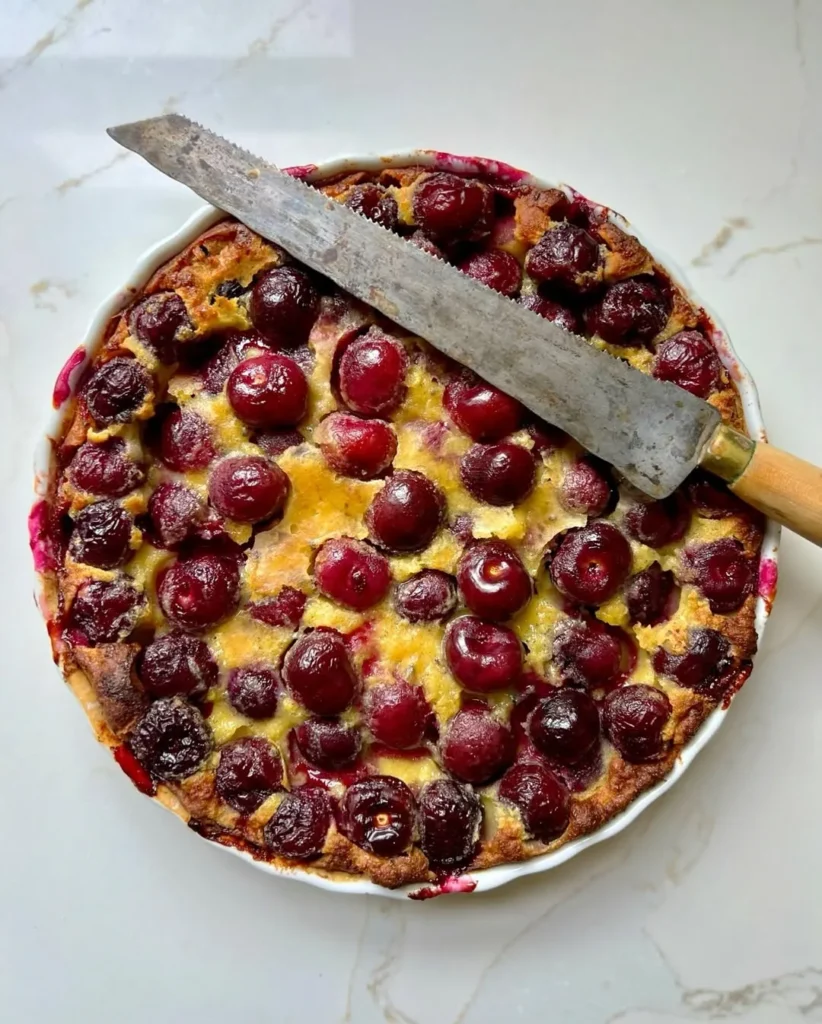
Cherry clafoutis is a classic French baked dessert of whole sweet cherries suspended in a smooth, lightly sweetened batter that sets somewhere between a custard and a crêpe during baking — puffed and golden at the edges, tender and yielding in the center, with the cherries soft and jammy and releasing their juice into the batter in tiny dark pockets throughout. The top is dusted with powdered sugar that melts slightly against the warm surface. The inside is silky and rich. Every spoonful has fruit, custard, and a warmth that belongs entirely to this dish.

This is the French dessert that requires no skill and no special equipment and produces something that looks and tastes genuinely impressive. One bowl. A whisk. A baking dish. Forty minutes in the oven.
Fifteen minutes to prep. Forty minutes to bake. A dessert that looks like it came from a Parisian patisserie and cost an afternoon to make.
Why You Will Love This Recipe
Cherry clafoutis belongs in your dessert repertoire permanently. Here is what makes this recipe worth making.
It is genuinely one of the simplest bakes that exists. The batter is whisked together in a single bowl in under five minutes. The cherries go in the dish. The batter goes over the top. The oven does everything else.
The result looks far more impressive than the effort. A golden, puffed baked custard with glossy cherries throughout looks like a serious dessert. The gap between effort and result is wider here than almost any other recipe in French cooking.
It is the best possible use of fresh cherries at their peak. When cherries are ripe and sweet in season, clafoutis is the answer. The oven concentrates their flavor and turns their juice into part of the batter.
It works warm, at room temperature, or cold. Serve it straight from the oven with cream or ice cream. Slice it cold from the fridge the next morning with coffee. Both are exceptional.
The batter is the most versatile dessert base you will learn. The same batter with different fruit produces a completely different dessert every time. One method, endless possibilities.
Ingredients
For the dish:
- 1 tablespoon unsalted butter, softened (for greasing)
- 1 tablespoon granulated sugar (for dusting the dish)
For the cherries:
- 500g (about 3 cups) fresh sweet cherries, pitted
- 1 tablespoon granulated sugar
- 1 tablespoon kirsch, cherry brandy, or fresh lemon juice
- ½ teaspoon pure vanilla extract
For the batter:
- 3 large eggs, room temperature
- ⅔ cup (130g) granulated sugar
- 1 cup (240ml) whole milk
- ½ cup (120ml) heavy cream
- ¾ cup (95g) all-purpose flour
- 2 tablespoons unsalted butter, melted and cooled
- 1½ teaspoons pure vanilla extract
- 1 teaspoon lemon zest
- ¼ teaspoon salt
- ¼ teaspoon almond extract (optional but traditional and excellent)
For finishing:
- Powdered sugar for dusting
- Fresh cream, crème fraîche, or vanilla ice cream for serving
Equipment Needed
- 10–11 inch (25–28 cm) round ceramic or glass baking dish, or a 9×13 inch oval dish
- Large mixing bowl
- Whisk
- Cherry pitter (recommended) or a small sharp knife
- Fine mesh sieve for dusting powdered sugar
- Measuring cups and spoons
Instructions
Step 1: Preheat the oven to 180°C (350°F). Rub the baking dish generously with the softened butter, covering the bottom and sides completely. Sprinkle the tablespoon of sugar over the butter and tilt the dish to coat evenly. Tip out the excess. The buttered and sugared dish creates a lightly caramelized crust on the bottom and sides of the clafoutis as it bakes.
Step 2: Pit the cherries. A cherry pitter makes this fast and clean. If you do not have one, use a small sharp knife to cut around the pit and pull it out. Some traditional French recipes leave the pits in — they add a faint almond flavor from the cherry kernel but require guests to be warned. Pitted cherries are more practical for serving.
Step 3: Toss the pitted cherries with 1 tablespoon of sugar, kirsch or lemon juice, and vanilla extract in a bowl. Set aside for 10 minutes. The sugar draws a little juice from the cherries and the kirsch deepens the cherry flavor. If serving to children or avoiding alcohol, lemon juice gives brightness without the liqueur.
Step 4: Make the batter. Whisk the eggs and sugar together in a large bowl for 1–2 minutes until pale and slightly thickened.
Step 5: Add the flour and salt. Whisk until completely smooth with no lumps. The batter will be thick at this stage.
Step 6: Gradually whisk in the whole milk and heavy cream until the batter is smooth and pourable, the consistency of thin pancake batter.
Step 7: Add the melted butter, vanilla extract, lemon zest, and almond extract if using. Whisk until fully incorporated. The batter should be completely smooth, thin, and lump-free. If any lumps remain, strain through a fine mesh sieve.
Step 8: Let the batter rest for 10 minutes. This allows the flour to hydrate fully and produces a smoother, more even set.
Step 9: Arrange the macerated cherries in a single even layer across the bottom of the prepared baking dish. Pour any accumulated cherry juices over them.
Step 10: Pour the batter slowly and evenly over the cherries. The cherries will float and distribute through the batter. Some will sink slightly. Some will stay near the surface. This is exactly right.
Step 11: Bake for 38–42 minutes until the clafoutis is puffed and golden at the edges, set through the center with only the slightest wobble when the dish is gently shaken, and a toothpick inserted into the custard portion comes out clean.
Step 12: Remove from the oven. The clafoutis will deflate slightly as it cools. This is completely normal and expected. It does not affect the flavor or texture.
Step 13: Dust generously with powdered sugar through a fine mesh sieve just before serving. The sugar melts slightly on the warm surface and creates a delicate, frosted finish.
Step 14: Serve warm, at room temperature, or cold directly from the baking dish. Spoon into shallow bowls. Add a spoonful of crème fraîche, a pour of cold fresh cream, or a scoop of vanilla ice cream alongside.
Substitutes & Swaps
Fresh cherries: Frozen cherries work well — thaw completely and drain thoroughly before using. Pat dry with paper towels. Excess moisture from frozen cherries makes the batter too wet and prevents it from setting properly. Canned cherries in juice work — drain very thoroughly and reduce the sugar in the batter by 2 tablespoons as canned cherries are sweeter.
Heavy cream: All whole milk works for a lighter, less rich result. The texture will be slightly less custardy and more pancake-like. All cream works for an extraordinarily rich, dense result closer to a baked custard tart.
Kirsch or cherry brandy: Fresh lemon juice is the best non-alcoholic substitute and adds brightness. Orange juice gives a more floral, sweet result. Both are excellent alternatives.
All-purpose flour: A 1-to-1 gluten-free flour blend works as a direct substitute. The texture is very slightly denser but the flavor is identical.
Granulated sugar: Caster sugar dissolves more quickly into the batter. Light brown sugar gives a very subtle caramel depth to the finished custard.
Almond extract: A small amount of finely ground blanched almonds folded into the batter gives a similar flavor and adds a gentle nuttiness to the texture. Both are optional but worth including.
Variations
Plum Clafoutis: Replace the cherries with halved, pitted plums. Arrange cut side up. The plums soften and release their juices into the batter in a dramatic, deep purple pool. Beautiful and deeply flavored.
Peach Clafoutis: Use ripe peaches, peeled, pitted, and cut into thick slices. Add a pinch of cinnamon and cardamom to the batter. A summer variation that is elegant and fragrant.
Pear and Vanilla Clafoutis: Peel and slice ripe pears thinly. Arrange in an overlapping fan pattern in the dish before pouring over the batter. Add the seeds of a vanilla pod to the batter alongside the extract. Delicate and beautiful.
Blueberry Clafoutis: Use whole fresh blueberries in place of cherries. They hold their shape well and burst slightly during baking, releasing dark blue juice into the surrounding custard. Excellent with a little lemon zest in the batter.
Chocolate Cherry Clafoutis: Add 2 tablespoons of cocoa powder to the batter and replace 2 tablespoons of flour with the cocoa. Scatter a handful of dark chocolate chips over the cherries before pouring the batter. Rich, dramatic, and worth making for anyone who loves the classic cherry and chocolate combination.
Individual Clafoutis: Divide the cherries and batter between eight buttered and sugared ramekins. Bake at 180°C for 22–25 minutes until set and puffed. Elegant for a dinner party where individual portions are preferable to a shared baking dish.
Tips & Tricks
Butter and sugar the dish properly. The layer of butter and sugar on the inside of the dish creates a thin, lightly caramelized crust on the bottom and sides of the clafoutis as it bakes. It also prevents sticking and makes serving clean and easy. Do not skip either step.
Pit the cherries but leave them whole. Whole pitted cherries hold their shape during baking and provide a distinct burst of fruit against the custard. Halved cherries release more juice but collapse more during baking. Whole cherries are the traditional choice and the better textural result.
Let the batter rest before baking. Ten minutes of resting allows the flour to absorb the liquid fully and produces a batter that sets more evenly and smoothly in the oven. A rested batter produces a more silky, uniform custard than one baked immediately after mixing.
Arrange the cherries before adding the batter. Place the cherries deliberately in an even single layer across the dish rather than adding them to the batter and then pouring both in together. An even distribution of fruit means every portion has cherries throughout. Adding the cherries to the batter first makes controlling the distribution impossible.
Do not overbake. The center of the clafoutis should have only the slightest wobble when the dish is shaken at the end of the baking time. The custard firms further as it cools. An overbaked clafoutis is rubbery and dry rather than silky and tender. Pull it when it is just barely set.
Expect it to deflate as it cools. Clafoutis puffs dramatically in the oven and settles back as it cools. This is not a failure. It is the nature of a custard-based bake. The texture and flavor are completely unaffected by the deflation.
Dust with powdered sugar just before serving. Powdered sugar dusted over the top too far in advance dissolves into the surface and disappears. Dust immediately before bringing it to the table for the full visual effect.
Nutrition Information (Per Serving)
| Nutrient | Amount |
|---|---|
| Calories | 220 kcal |
| Total Fat | 9g |
| Saturated Fat | 5g |
| Carbohydrates | 30g |
| Fibre | 1g |
| Sugars | 22g |
| Protein | 5g |
| Sodium | 100mg |
Nutrition is based on one serving of clafoutis made with cherries, eggs, whole milk, heavy cream, flour, butter, and sugar. Cream, crème fraîche, or ice cream not included.
Frequently Asked Questions (FAQs)
Do I have to pit the cherries?
Traditionally, no. Classic French clafoutis is made with whole unpitted cherries. The pits are said to release a subtle almond flavor from the kernel as the clafoutis bakes. If you leave the pits in, warn guests clearly before serving. For practical, comfortable eating — especially for children — pitting the cherries is the better choice.
Can I use frozen cherries?
Yes. Thaw completely and drain very thoroughly. Spread on paper towels and pat dry. Excess water from frozen cherries makes the batter too wet to set properly. Dried frozen cherries produce results very close to fresh. The texture is slightly softer after baking but the flavor is excellent.
My clafoutis is not setting in the center. What do I do?
Return it to the oven for 5 additional minutes and check again. If the edges are very dark before the center sets, reduce the oven temperature by 10 degrees and continue baking. An oven that runs hot will overcook the edges before the center has time to set. An oven thermometer removes this uncertainty entirely.
Can I make this ahead of time?
Yes. Clafoutis is excellent made the day before. Cool completely, cover, and refrigerate. Serve cold or return to a 160°C oven for 10 minutes to warm through. The texture is slightly denser cold but equally delicious. The flavor deepens overnight.
Why is my clafoutis rubbery?
It was overbaked. The eggs in the batter set and then continue to tighten the longer they stay in the oven past the correct point. Pull the clafoutis when the center has only a very faint wobble. The residual heat finishes the setting. A perfectly baked clafoutis is silky and tender, never rubbery.
Can I make this in a cast iron skillet?
Yes. A well-seasoned 10–11 inch cast iron skillet works well. Butter and sugar it exactly as you would a ceramic dish. The clafoutis bakes slightly faster in cast iron — start checking at 33–35 minutes. The bottom develops a more pronounced crust from the cast iron which many people prefer.
What is the difference between clafoutis and flaugnarde?
Clafoutis is the correct name only when made with cherries — specifically black cherries from the Limousin region of France where the dish originates. When the same batter and method is used with any other fruit — plums, pears, peaches, blueberries — the dish is technically called a flaugnarde. In practice, the name clafoutis is used colloquially for all versions regardless of fruit.
The Dessert That Makes France Make Sense
There is a reason this dish has existed in French kitchens for centuries. It asks very little. It gives back enormously. A handful of cherries. A simple batter. An oven. Forty minutes. The result is something that sits between a custard, a crêpe, and a tart in the most elegant possible way. Golden at the edges. Silky in the middle. Cherries jammy and dark and glossy throughout.
Serve it warm with crème fraîche on a summer evening. Slice it cold from the fridge the next morning with strong coffee. Bring it to the table still in the baking dish, dusty with powdered sugar, and watch everyone’s face when they realize something this simple can look this good.
It is the dessert that makes you feel like you know something other people do not. The secret is that there is no secret. Just good cherries, a whisked batter, and an oven that does all the work.
Made this cherry clafoutis? Tell me in the comments whether you pitted the cherries, what you served alongside it, and whether you tried a different fruit. I want to hear every detail.

Cherry Clafoutis
Ingredients
- For the Dish:
- 1 tablespoon unsalted butter softened
- 1 tablespoon granulated sugar
- Cherries:
- 500 g fresh sweet cherries pitted
- 1 tablespoon granulated sugar
- 1 tablespoon kirsch cherry brandy, or fresh lemon juice
- ½ teaspoon pure vanilla extract
- Batter:
- 3 large eggs room temperature
- ⅔ cup granulated sugar
- 1 cup whole milk
- ½ cup heavy cream
- ¾ cup all-purpose flour
- 2 tablespoons unsalted butter melted and cooled
- 1½ teaspoons pure vanilla extract
- 1 teaspoon lemon zest
- ¼ teaspoon salt
- ¼ teaspoon almond extract optional
- Finishing:
- Powdered sugar for dusting
- Crème fraîche fresh cream, or vanilla ice cream for serving
Instructions
- Preheat oven to 180°C (350°F). Butter the baking dish generously. Add sugar and tilt to coat. Tip out excess.
- Pit the cherries. Toss with sugar, kirsch or lemon juice, and vanilla. Rest 10 minutes.
- Whisk eggs and sugar together for 1–2 minutes until pale and slightly thickened.
- Add flour and salt. Whisk until completely smooth.
- Gradually whisk in whole milk and heavy cream until batter is thin and smooth.
- Add melted butter, vanilla, lemon zest, and almond extract if using. Whisk until fully combined.
- Rest the batter for 10 minutes.
- Arrange macerated cherries in an even single layer across the prepared dish. Pour any cherry juices over them.
- Pour batter slowly and evenly over the cherries.
- Bake 38–42 minutes until puffed and golden at the edges and just barely set in the center with a faint wobble.
- Cool briefly. Expect deflation — this is normal.
- Dust generously with powdered sugar just before serving.
- Serve warm or at room temperature with crème fraîche, cream, or ice cream alongside.
Notes
- Butter and sugar the dish thoroughly — this creates a caramelized crust and prevents sticking
- Whole pitted cherries give the best texture — leave them whole, do not halve
- Rest the batter 10 minutes before baking — hydrated flour produces a smoother, more even set
- Arrange cherries in the dish before pouring the batter for even fruit distribution
- Do not overbake — a faint wobble in the center at the end of baking is correct
- The clafoutis will deflate as it cools — this is expected and does not affect quality
- Dust with powdered sugar just before serving — it dissolves if added too early
- Excellent made the day before — flavor deepens overnight in the fridge
- Cast iron works well — start checking 5 minutes earlier than the recipe states
- Technically called flaugnarde when made with any fruit other than cherries